

Manufacturer:
Italy
Supplier:
Medical Specialties:
Product Description
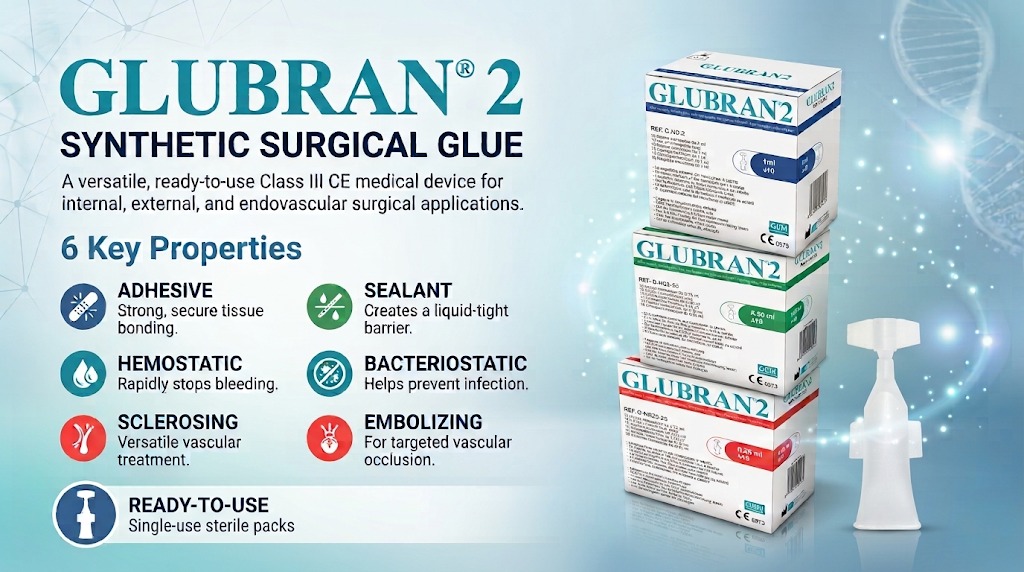
Glubran 2 is a synthetic biodegradable cyanoacrylate-based surgical glue, modified by the addition of a monomer synthesized by the manufacturer GEM. It is a Class III MDR medical device marked for internal and external use.
Glubran 2 is ready for use. It has high adhesive, haemostatsis and Sealing properties and once polymerized it creates an efficient antiseptic barrier against the most diffused infective or pathogenic agents during surgical intervention.
Glubran 2 polymerises quickly in contact with live tissue and wet environment, creating a thin and elastic film with high tensile strength which guarantee strong adhesion to the tissues. This film naturally conforms with the tissues on which it was applied; it is not permeable to liquids and is not altered by blood or organic liquids.
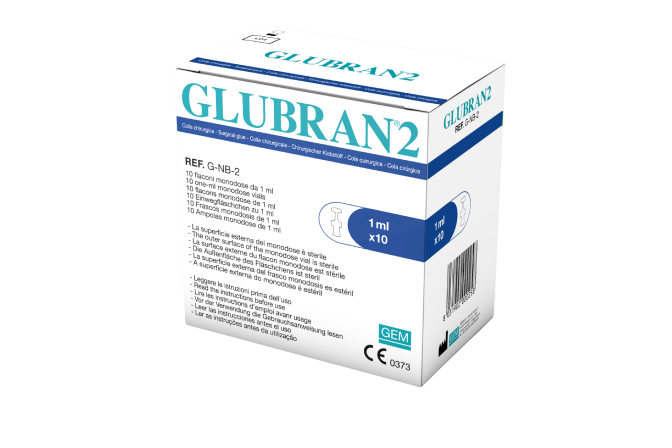
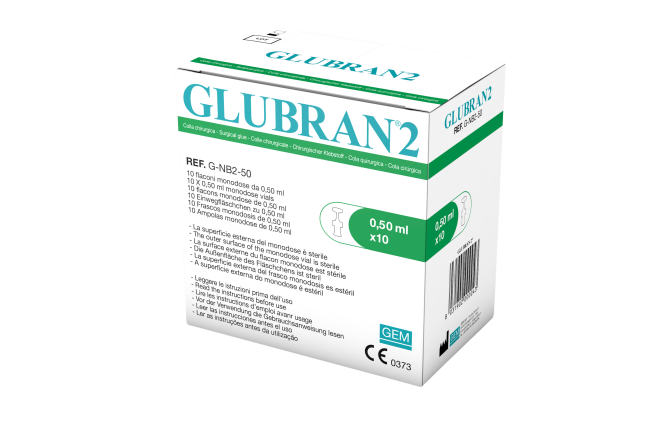
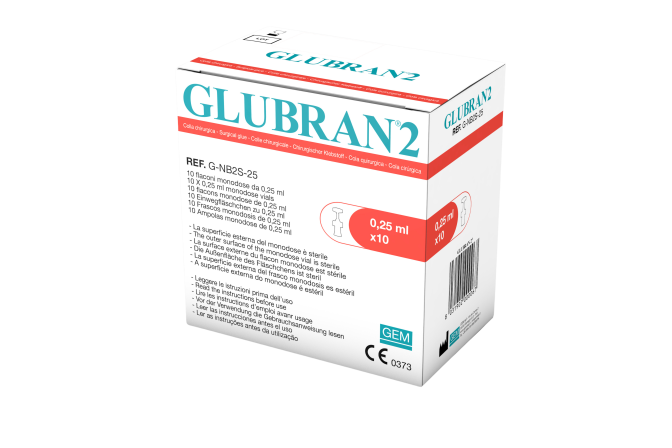
Available Sizes
1ml | 0.5ml | 0.25ml
Examples of Indications by Medical Specialty
- As a sealant in the endoscopic treatment of oesophageal, gastric, gastrointestinal, duodenal and pancreatic fistulas
- As a hemostat and sealant in the endoscopic treatment and prevention of bleeding following gastrointestinal mucosal and submucosal resection
- As a hemostatic in the endoscopic treatment of bleeding gastroduodenal ulcers
- As a sclerosant in the endoscopic treatment of oesophageal, gastric and duodenal varices
- As a reinforcing sealant for immediate aerostasis and increased mechanical sealing
- As a sealant for bronchial and bronchopleural fistulas
- As an adhesive and haemostatic in vaginal and perineal plastics
- As a sealant for the prevention and treatment of inguinal lymphocele and lymphorrhoea
- As a surgical mesh bonding agent for the treatment of prolapse
- As a haemostatic and sealant during kidney transplant
- As a sealant and haemostatic on lacerations and haemorrhagic renal injuries
- As a sealant and haemostatic of the excretory route in partial nephrectomy surgery
- As a sealant in the treatment of urinary fistulas
- As a sealant in the treatment of post-surgery lymphorrhoea
- As a suture substitute in phimosis, circumcision and frenulotomy surgery
- As a graft adhesive in urethroplasty procedures
- As a haemostatic on endoscopic resections of bladder tumours
- As an adhesive in the plasticization of hernias and incisional hernias with patch/mesh in both traditional and laparoscopic surgery
- As a sealant in the treatment of proctological fistulas
- As sealant and reinforcement of gastrointestinal and rectal anastomoses
- As a sealant in the treatment of gastrocutaneous fistulas
- As sealant for prevention of bilomas and biliary fistulas following liver resection
- As a haemostatic on parenchymal tissues (liver, pancreas, spleen, etc.) on internal epithelial, muscle and adipose tissue
- As a haemostatic on resections or lesions of parenchymatous organs (liver, kidney, pancreas, spleen)
- As a sealant and haemostatic on lung biopsies
- As a suture substitute in circumcision and hypospadias
- As a sealant and haemostatic in closing organ perforations
- As a sealant in the treatment of fistulas
- As a sclerosant in the treatment of gastro-oesophageal varices
- As an adhesive and sealant in the closure of the patent processum vaginalis
- As an adhesive and haemostatic for skin flap adhesion in abdominoplasty procedures
- As a sealant in the prevention and treatment of seroma in abdominoplasty
- As an adhesive and haemostatic in rhinoplasty surgery
- As an adhesive in breast reconstructive surgery
- As a sealant for the treatment of CSFs in nasal-paranasal and pituitary surgery
- As a sealant for the treatment of pharyngocutaneous and oroantral fistulas
- As an adhesive in nose and paranasal sinuses surgery
- As a sealant of palatal sutures in cleft lip and palate surgery
- As an adhesive for bonding bone-cartilage fragments
- As an adhesive to promote skin engraftment
- As an adhesive for stabilizing the bone window in sinus lift surgery
- As an adhesive for the stabilization of bio-filler materials in guided bone regeneration procedures
- As an adhesive for closing endodontic-oral incisions
- As a hemostatic and suture-reinforcing sealant on anastomoses (vessel-vascular and prosthetic-vascular)
- As an adhesive for the treatment of iatrogenic pseudoaneurysms, via percutaneous injections
- As a filler and sclerosing agent for the treatment of varicose and insufficient veins of the lower limbs, by endovascular injection
- As an adhesive and sealant for bonding patches on dural tissue
- As a sealant to prevent liquor fistulas for trans-sphenoidal closure of the sella turcica
- As an adhesive and sealant for bonding bone and osteocartilaginous fragments
- As an adhesive and sealant for bonding patches on dural tissue
- As a sealant to prevent liquor fistulas for trans-sphenoidal closure of the sella turcica
- As an adhesive and sealant for bonding bone and osteocartilaginous fragments
- As an embolizing agent in embolization and sclerosis of arteries and veins
- As an embolizing agent in the treatment of vascular malformations and fistulas
- As an embolizing agent in the treatment of endoleak
- As a sealant in the treatment of postsurgical fistulas
- As a prostatic artery embolizing agent in the treatment of prostate adenoma
- As an adhesive for bonding adipose tissue in omentoplasty procedures after sleeve gastrectomy
- As sealant and suture reinforcement after Sleeve Gastrectomy or Roux-en Y Gastroenterostomy
- As sealant for the prevention and treatment of seroma and lymphorrhoea following mastectomy, quadrantectomy and axillary lymphadenectomy procedures
- As an adhesive for fixation of the conjunctival flap in pterygioplasty surgery
- As a sealant and adhesive for closing corneal perforations
- Sealing and hemostasis of liver and pancreatic resections, to prevent the formation of biliary and pancreatic bilomas and fistulas, or post-operative bleeding
- Sealing of anastomoses in the reconstruction of bile and pancreatic ducts, to prevent leaks
- Sealing and reinforcement of vascular sutures, also during liver transplant procedures
- Hemostasis for oozing hemorrhages after detachments and dissections